| metric | value |
|---|---|
| area under ROC curve | 0.77 |
| area under precision-recall curve | 0.39 |
| accuracy | 0.60 |
| precision | 0.26 |
| recall | 0.82 |
| f1 score | 0.39 |
| mean log loss | 0.77 |
| gini coefficient | 0.54 |
| brier skill score | 0.15 |
utility shut-off warning
WarningStaging
Built from the latest training run on 2026-11-21 18:30 UTC, not from a released model set. The released documentation is at https://matter.indigo.engineering/docs/.
This model predicts whether a household has received a utility shut-off warning — a strong signal of acute financial distress.
Trained on survey data, it combines household composition indicators, geographic context, and income-level features to identify voters at risk of energy insecurity.
Organizations can use these scores to connect at-risk households with utility assistance programs and energy affordability advocacy.
0.24average scoreAbout 24% of people on the voter file.
2.3×Most likely vs. randomImprovement over random selection in the top score segment.
0.77area under ROC curveThe model's ranking quality; 0.5 is random
Using this score
Every person gets a likelihood segment. Most likely is sized to the share of people who actually have this trait, up to a third. Somewhat likely is the next group of the same size.
Most likely
scores 0.37–0.9424% of people2.3×vs. randomSomewhat likely
scores 0.19–0.3623% of people1.1×vs. randomLeast likely
scores 0.04–0.1853% of people0.4×vs. randomPick your list
New to Matter? Start hereA set number of people
ORDER BY affordability_utility_shut_off_warning DESC LIMIT 5000The Most likely segment, from the segments table
affordability_utility_shut_off_warning = 'Most likely'How many have the trait in an area
SUM(affordability_utility_shut_off_warning)How it compares with published figures
24%
of people with scored records have received a utility shut-off warning in the past year, by our model.
In 2025, 21.5M U.S. households (~16%) were behind on utility bills (2025 NEADA). Utility bills have been rising sharply, with an estimated 8.5% increase expected in 2026 (2026 NYT).
How well it works
We held back some survey answers to test the model. In that test, the tenth of people it scored highest had this trait 2.8 times as often as average. The lowest tenth had it 0.09 times as often.
About this model
- column
affordability_utility_shut_off_warning- model type
- DNN classifier
- training rows
- 5,465
- last trained
- 2026-10-15
- area under ROC curve
- 0.77
- area under precision-recall curve
- 0.39
all metrics and calibration
Metrics
Calibration
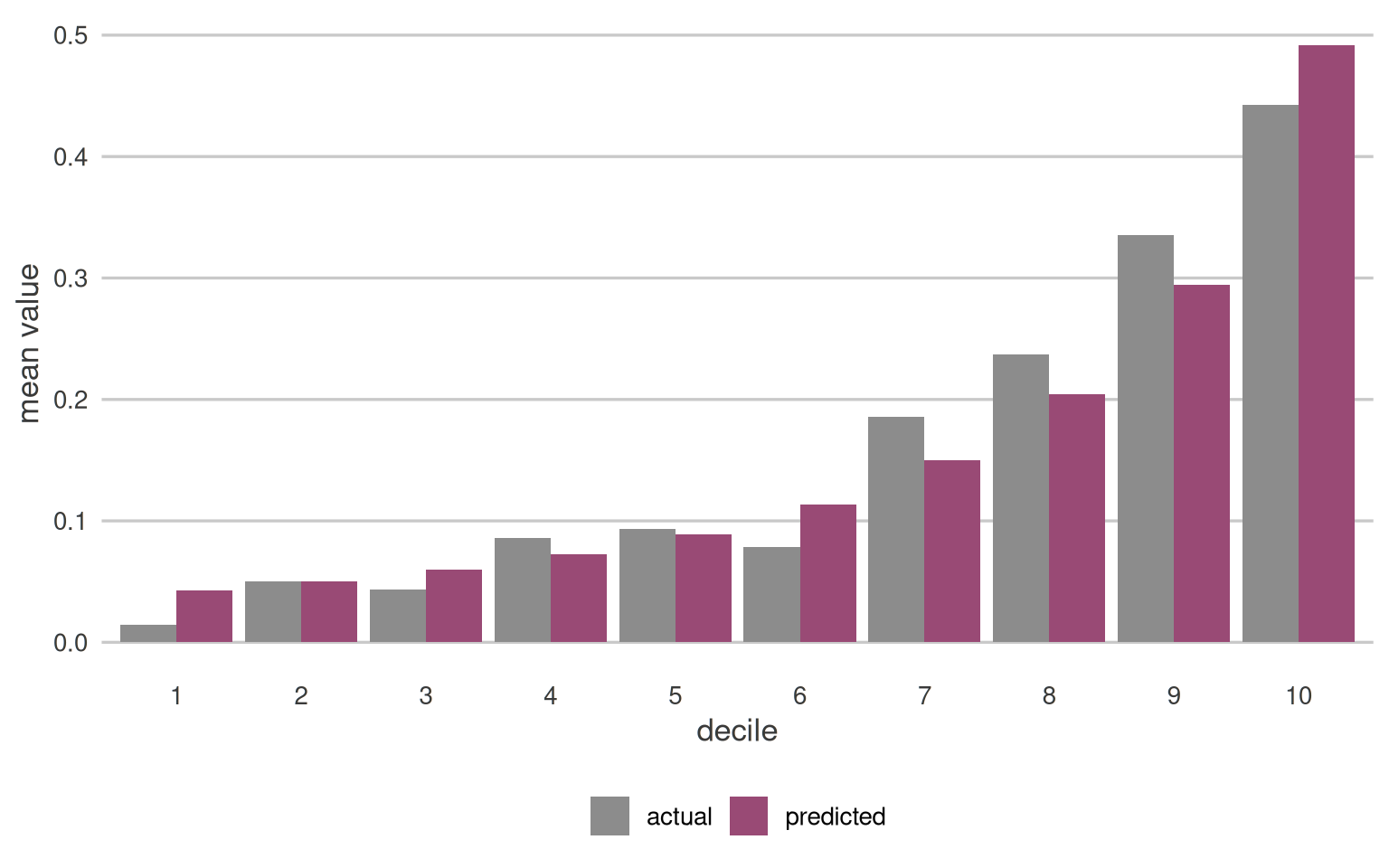
Bars of similar height within each decile indicate well-calibrated predictions. Systematic differences reveal where the model over- or under-predicts.
Cumulative gains
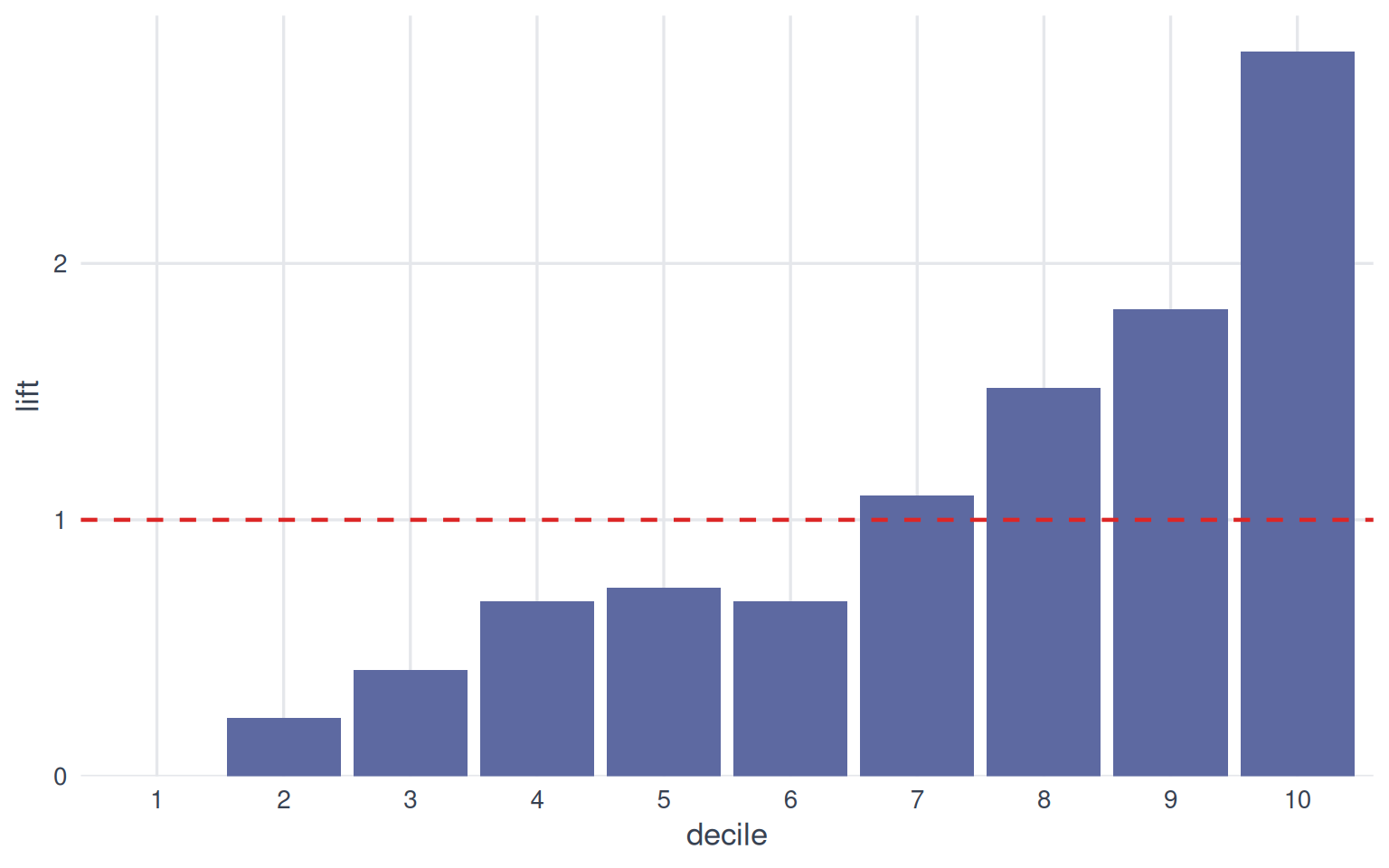
The further the model curve bows above the diagonal, the better the model concentrates the outcome in its top-ranked predictions.
Deciles
| decile | count | mean actual | mean predicted | mae | lift |
|---|---|---|---|---|---|
| 10 | 140 | 0.44 | 0.49 | 0.05 | 2.83 |
| 9 | 140 | 0.34 | 0.29 | 0.04 | 2.14 |
| 8 | 139 | 0.24 | 0.20 | 0.03 | 1.51 |
| 7 | 140 | 0.19 | 0.15 | 0.04 | 1.18 |
| 6 | 140 | 0.08 | 0.11 | 0.03 | 0.50 |
| 5 | 139 | 0.09 | 0.09 | 0.005 | 0.60 |
| 4 | 140 | 0.09 | 0.07 | 0.01 | 0.55 |
| 3 | 139 | 0.04 | 0.06 | 0.02 | 0.28 |
| 2 | 140 | 0.05 | 0.05 | 0.0003 | 0.32 |
| 1 | 140 | 0.01 | 0.04 | 0.03 | 0.09 |
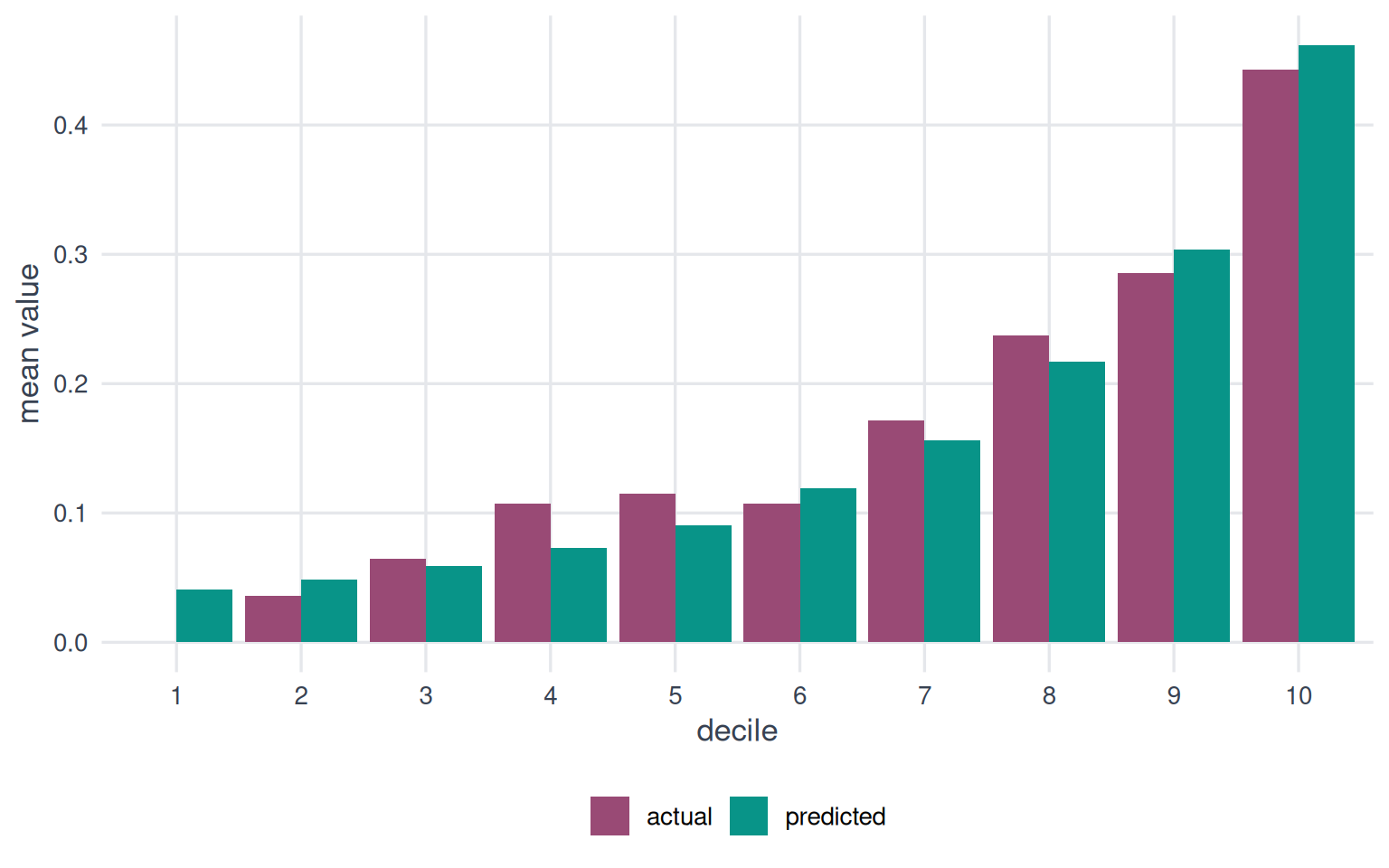
score distribution
| statistic | value |
|---|---|
| mean | 0.24 |
| std dev | 0.20 |
| min | 0.04 |
| 25th | 0.08 |
| median | 0.17 |
| 75th | 0.35 |
| max | 0.94 |
features
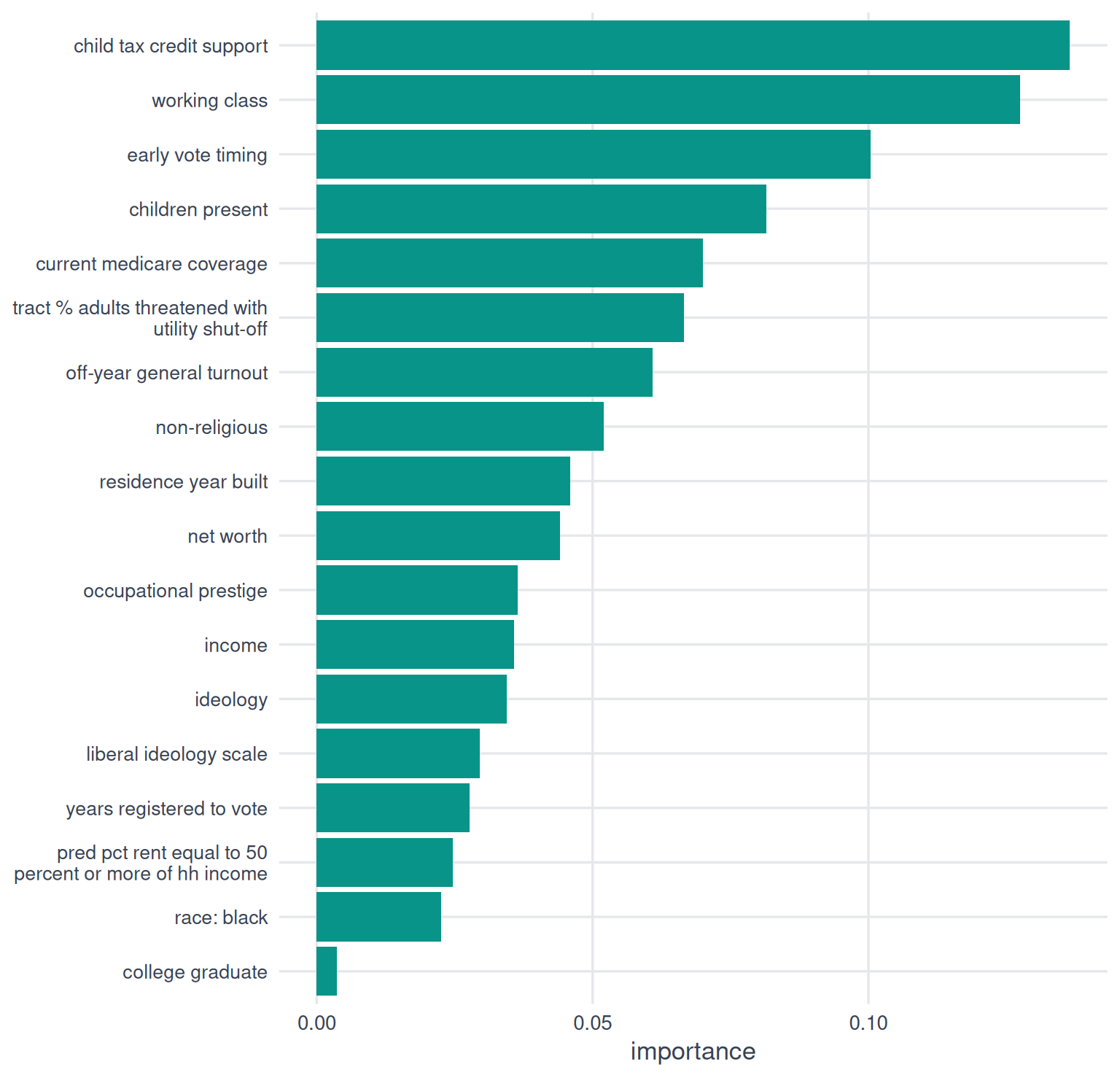
Importance
Sourcing
Agency for Healthcare Research and Quality
- tract % renter-occupied units with children
CDC PLACES
- tract % adults threatened with utility shut-off
Revelio Labs
- min salary
- occupational prestige score
State voter files (via TargetSmart)
- years registered to vote
TargetSmart
- child tax credit support score
- children present score
- college graduate score
- early vote / absentee vote score
- early vote timing score
- ideology score
- local election voter score
- non-religious score
- off-year general turnout score
- race: black
- working class score
unknown
- pred pct rent equal to 50 percent or more of hh income
Verisk (via TargetSmart)
- income
- liberal ideology scale
- net worth
- residence year built
architecture
This model is a deep neural network classifier trained with BigQuery ML.
Hyperparameter configuration
- max iterations: 20
- learn rate: 5e-04
- l1 regularization: 0
- l2 regularization: 0
- min relative progress: 0.01
- warm start: FALSE
- early stop: TRUE
- input label columns: affordability_utility_shut_off_warning
- data split method: AUTO_SPLIT
- hidden units: 256, 128
- batch size: 32
- dropout: 0.292
- num trials: 18
- max parallel trials: 5
- hparam tuning objectives: ROC_AUC
- TF version: 2.17.0
- auto class weights: FALSE
- activation fn: relu
- optimizer: adam